How Would Your Cheminformatics Tool Do This? 3

Reference: Shi, Ma, and Gao, J. Org. Chem.
Posted by Rich Apodaca Thu, 08 Nov 2007 08:51:00 GMT

Reference: Shi, Ma, and Gao, J. Org. Chem.
I'm Rich Apodaca, a chemist and software developer in San Diego, California. By day I run Metamolecular, LLC, maker of ChemWriter™, the 2D chemical structure editor and renderer for Web applications.
Please send questions and comments to: rich...@yahoo.com.
2d acs applet axialchirality casualsaturdays cdk chemwriter editor flexmol inchi integration java openaccess opensource pubchem rails rcdk ruby smiles web
© 2006-2007 Richard L. Apodaca
Content licensed under the Creative Commons Attribution-Share Alike 3.0 United States License.

Hi Rich, doing what?
Posting the whole reaction in SMARTS to openmolecules.net extracting data out of the GIF/PDF using a Hamburger to Cow conversion?
Tell me :-) I will pay a lot of money for it and become Editor of my own journal which requires the usage of such a tool for posting chemical reactions.
Tobias
Hi, ... for those people who think this is just a fun question, think about why most of the chemical drawing software tools are not capable of doing that (sending a SMARTS/MARKUSH encoded reaction together with the TIFF/PNG picture to the publisher).
The same is true for INCHIKey + SMILES + SMARTS + CML, RDF data? Organic chemists waste a lot of time handcrafting their reaction to a bitmap picture (aka picture crap - which only can be de-coded by the chemists mind) which requires human interaction or a error-prone OCR technique to convert it back into a machine readable function.
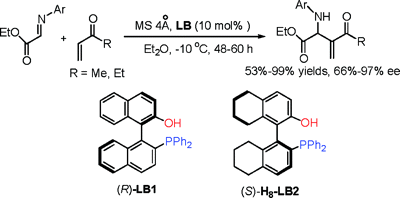
I would like to have a least (no R/S, Z/E) something like c\N=C\C(=O)OC[#6].C(=O)C=C>>cNC(C(=C)C()=O)C(=O)OC[#6] (didn't check the reaction, just to give an example).
Counter-Question: How would your cheminformatics tool do that (including INCHIKey + SMARTS or CML, RDF) ?
Tobias
Tobias, thanks for your comments. The more items on this series I post, the more I realize how useful it is to just post an image and a question. Readers come up with so many more interesting things than I could think of on my own.
All of your points are good ones. I was actually more interested in the bottom of the abstract. Unambiguously representing the axial chirality of the two biaryls is next to impossible with most of the cheminformatics tools available today. This include file formats, editors, databases, and toolkits.
But chemists, and organic chemists in particular, aren't paying attention to the plight of cheminformaticians - they keep making and using enantiomerically pure biaryls with wild abandon!
Ready or not, these unruly beasts are coming soon to a cheminformatics system near you. eNotebooks will probably be the leading wave.