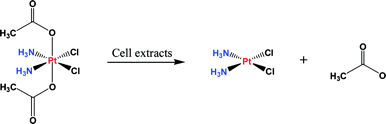
How Would Your Cheminformatics Tool Do This? 5

Posted by Rich Apodaca Tue, 30 Oct 2007 09:30:00 GMT

Comments

Leave a response

  1. Egon Willighagen Tue, 30 Oct 2007 10:11:22 GMT

    Rich, this is an interesting one... do you really mean the Pt is not a more common planar 4-coordinate, with two ionic coordination bonds, or so? Maybe even in the second coordination shell?

    The drawing clearly does not describe such semantics. Worse, what happened to the charges?

    So, should my chemoinformatics tool be allowed to represent this, or should it warn about fuzzy chemistry?

  2. Rich Apodaca Tue, 30 Oct 2007 12:52:58 GMT

    Egon, I don't have access to the paper (;-)), but from the abstract, it looks like the authors have made a less-common Pt(IV) complex that gets reduced in vivo to the more common Pt(II) species. I don't think formal charges are necessary (certainly no representation of cisplatin I've seen has them).

    I was actually just thinking about the simple case of representing the stereochemistry present in cisplatin and in the octahedral precursor.

    Many folks consider these kinds of transition metal complexes mere chemical oddities - with no need for further consideration.

    The problem is that these kinds of complexes are popping up in all sorts of biological studies. So they're being associated with exactly the kinds of data many of the most important chemical databases these days contain.

    The fact that the above article is published in none other than J. Med. Chem. speaks volumes for what's happening.

    Cisplatin and transplatin are very different beasts from a biological perspective (and most other perspectives, btw).

    If the tools used to create chemical databases can't comprehend the distinction... well, that's a problem, isn't it?

  3. baoilleach Wed, 31 Oct 2007 04:38:53 GMT

    "Worse, what happened to the charges?"

    The only thing we can say for certain is that the molecule as a whole has a particular charge. In this case, it's neutral. How that charge is distributed among the different atoms is a question of what type of model we use to partition the electrons... for example, formal charges will give a much different answer than partitioning the electron density from a QM calculation...

  4. Egon Willighagen Wed, 31 Oct 2007 04:45:08 GMT

    Yes, that would certainly be a problem :) And I recognize this problem. This is why JChemPaint is not so 'powerful' as other drawing programs, because it requires semantic representation for all drawing elements.

    BTW, I still think we should better move into a 3D world. The technology is there, only our chemoinformatics 'editors' are not up to the job yet.

  5. Egon Willighagen Wed, 31 Oct 2007 04:47:39 GMT

    Regarding the charges... pay close attension... left side is neutral, if the Pt(IV) is correct. The right side is negatively charged... though I assume the authors meant the protonated form of the acid. I can only assume this, and derive this from the magic words 'cell extracts' which will most likely include water.

Comments