Can Your Cheminformatics Tool Do This? 4

Posted by Rich Apodaca Tue, 02 Oct 2007 10:10:00 GMT

Comments

Leave a response

  1. ChemSpiderMan Tue, 02 Oct 2007 22:02:42 GMT

    What do you want to do? Just redraw the reaction?

  2. Rich Apodaca Tue, 02 Oct 2007 23:06:50 GMT

    Antony,

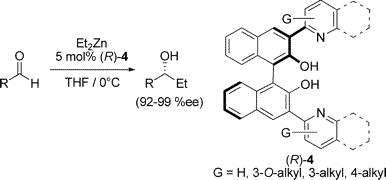
    I'm asking about representing the axial chirality of the binol in such a way that its enantiomers can be distinguished by a computer program.

    Axial chirality is one of those things that cheminformatics hasn't really come to grips with yet. But nobody told the Organic Chemists that.

  3. Joerg Kurt Wegner Wed, 03 Oct 2007 12:09:33 GMT

    Lets assume that FlexMol can do all of this ... is there already enough "open standard" available to encode it as superset of mol, mol2, and cml files?

    After this question is solved, are things still efficient enough for being usable for millions of molecules?

  4. Rich Apodaca Wed, 03 Oct 2007 12:38:18 GMT

    Joerg, good questions.

    FlexMol is a superset of molfile, SMILES, InChI, and CML in that it can encode any molecule those formats can, and many others as well. I haven't found any exceptions in the last few years of actively looking. I'm not as familiar w/ mol2.

    As for efficiency, that depends on the implementation. So far, there is only one, the Octet Framework. Octet was written a few years ago now, and there are many things I don't like about it as a toolkit. It could no doubt be made more efficient. But it does fully support FlexMol.

    You can convert SMILES and Molfiles into FlexMol. Within certain limits, you can also convert them back. You can do query atom searches and stereo-substructure searches on FlexMol representations. In addition to precisely representing metallocenes, piano stool complexes, planar chiral organometallics, and allene, helicine, and biaryl stereochemistry.

    It comes at a price. FlexMol can be very verbose. It can be misused. It's hard to write readers and writers. But it does work.

Comments