From InChI to Image with Ruby Open Babel and Ruby CDK
Like SMILES, InChI is a line notation that can be used to encode and store chemical information relatively efficiently. Although there are a number of scenarios where this strategy is used, what many of them have in common is the need to eventually convert an InChI into a human-readable form. In most cases, this form will be a 2D chemical structure. This article will show how a small Ruby library can convert InChI strings into color PNG images with the help of Ruby Open Babel and Ruby CDK.
The Library
Our library accepts an InChI as input and produces a scaled PNG image as output. It re-uses part of a previously-discussed library for the interconversion of SMILES and InChI.
require 'rubygems'
require 'openbabel'
require_gem 'rcdk'
require 'rcdk/util'

module InChI
  @@to_smiles = OpenBabel::OBConversion.new
  @@to_smiles.set_in_and_out_formats 'inchi', 'smi'

  def inchi_to_png inchi, path_to_png, width, height
    smiles = inchi_to_smiles inchi

    RCDK::Util::Image.smiles_to_png smiles, path_to_png, width, height
  end

  private

    def inchi_to_smiles inchi
      mol = OpenBabel::OBMol.new

      @@to_smiles.read_string(mol, inchi) or raise "Can't parse InChI: #{inchi}."
      @@to_smiles.write_string(mol).strip
    end
end
Testing
Our library can be tested by saving it to a file called inchi.rb and using interactive Ruby (the warning can safely be ignored for now):
irb
irb(main):001:0> require 'inchi'
./inchi.rb:3:Warning: require_gem is obsolete.  Use gem instead.
/usr/local/lib/ruby/gems/1.8/gems/rcdk-0.3.0/lib/rcdk/java.rb:26:Warning: require_gem is obsolete.  Use gem instead.
i=> true
irb(main):002:0> include InChI
=> Object
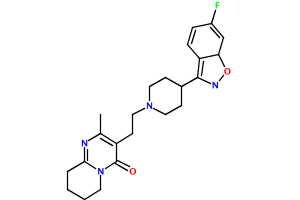
irb(main):003:0> inchi='InChI=1/C23H27FN4O2/c1-15-18(23(29)28-10-3-2-4-21(28)25-15)9-13-27-11-7-16(8-12-27)22-19-6-5-17(24)14-20(19)30-26-22/h5-6,14,16H,2-4,7-13H2,1H3' #risperidone
=> "InChI=1/C23H27FN4O2/c1-15-18(23(29)28-10-3-2-4-21(28)25-15)9-13-27-11-7-16(8-12-27)22-19-6-5-17(24)14-20(19)30-26-22/h5-6,14,16H,2-4,7-13H2,1H3"
irb(main):004:0> inchi_to_png inchi, 'risperidone.png', 300, 300
=> nil
This code produces the following image:
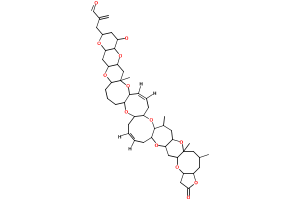
Our library can also be used on more complicated molecules, for example Brevetoxin:
irb
irb(main):001:0> require 'inchi'
./inchi.rb:3:Warning: require_gem is obsolete.  Use gem instead.
/usr/local/lib/ruby/gems/1.8/gems/rcdk-0.3.0/lib/rcdk/java.rb:26:Warning: require_gem is obsolete.  Use gem instead.
=> true
irb(main):002:0> include InChI
=> Object
irb(main):003:0> inchi='InChI=1/C49H70O13/c1-26-17-36-39(22-45(52)58-36)57-44-21-38-40(62-48(44,4)23-26)18-28(3)46-35(55-38)11-7-6-10-31-32(59-46)12-8-14-34-33(54-31)13-9-15-43-49(5,61-34)24-42-37(56-43)20-41-47(60-42)30(51)19-29(53-41)16-27(2)25-50/h6-8,14,25-26,28-44,46-47,51H,2,9-13,15-24H2,1,3-5H3/b7-6-,14-8-' #brevetoxin a
=> "InChI=1/C49H70O13/c1-26-17-36-39(22-45(52)58-36)57-44-21-38-40(62-48(44,4)23-26)18-28(3)46-35(55-38)11-7-6-10-31-32(59-46)12-8-14-34-33(54-31)13-9-15-43-49(5,61-34)24-42-37(56-43)20-41-47(60-42)30(51)19-29(53-41)16-27(2)25-50/h6-8,14,25-26,28-44,46-47,51H,2,9-13,15-24H2,1,3-5H3/b7-6-,14-8-"
irb(main):004:0> inchi_to_png inchi, 'brevetoxin.png', 300, 200
=> nil
This produces the following image:
Conclusions
While our library could certainly be improved, it solves what otherwise would be a very difficult problem conveniently. Areas for further work include error handling and improving the appearance of the images (the latter is the aim of Firefly). Despite the fact that three programming languages are used (Ruby, C++, and Java), this complexity is neatly encapsulated behind a simple Ruby interface.