Name That Graph Revealed: Oligarchy 2.0 5
Web 2.0 may be all about participation, but the numbers reported by The McKinsey Quarterly suggest a self-selecting oligarchy rather than a democracy. Success may well depend more on engaging the top 2-10% of users rather than appealing to all of them. Food for though when forming your next community, be it electronic or otherwise.
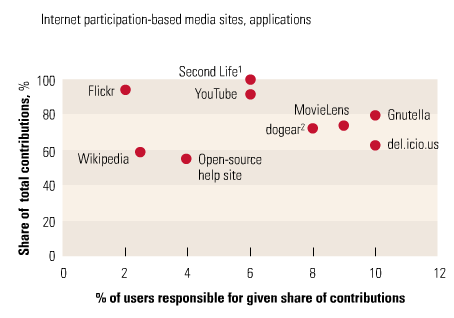
image credit: The McKinsey Quarterly


Hey come on! They have approximated a curve by a point. How could we have guessed that? :-)
I've heard this long described as the "ten-percent rule," well before the beginnings of the web, much less Web 2.0.
Other times, we refer to these people as "early adopters." If you've read Malcom Gladwell's The Tipping Point, you might call these people "The Law of the Few."
I bet if you take any e-mail list, you'll see that at most 10% of the readers are active contributors. The same goes for open source projects -- how many users are there compared to active developers?
Unfortunately Google is disappointing me -- I can't find references to the rule, but I first heard it 10 years ago or more.
Geoff,
Your comments about this effect in open source remind me of the article Myths Open Source Developers Tell Ourselves.
Here is something interesting saying the same ... only a few make the most contributions http://www.aaronsw.com/weblog/whowriteswikipedia
I have heard of the 20/80 rule where for example 80% of your business comes from 20% of your clients. I am not surprised at the 2-10% data as there are so many Web 2.0 sites. Which ones to choose when you get different friends and colleagues inviting you to many different social sites